
Is DX Moving Away From Code?
Railix explores a developer experience where the system is a visible model, rather than a mental model developers build from the codebase.
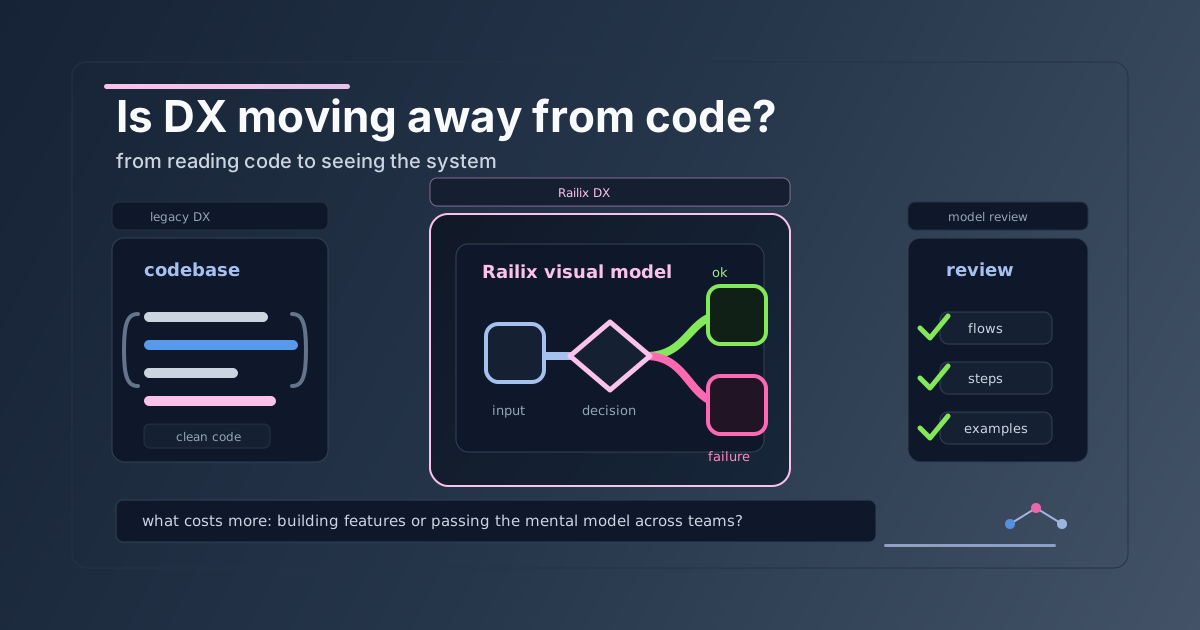
Historically, developer experience has been tied to code: clean code, readable modules, nice abstractions, fast tests, naming conventions and package boundaries.
For technical people who find beauty in well-structured code, that is not superficial. Clean code is how we have made software with huge codebases understandable to other developers.
A good codebase has a kind of architecture that makes one want to read. Responsibilities sit in the right places. Names carry intent. Modules do not leak into each other. Tests explain expected behavior. A new developer can open the project and build a mental model.
That has been the craft.
However, anyone who has built large systems by hand knows the truth: even beautiful code is iterative. You move responsibilities around. You rename things. You split services. You rework the model.
So developer experience in large codebases has quietly meant something bigger than editor tooling. How well can a developer manage the complexity of a large growing codebase?
Clean code is a big part of DX
Clean code matters. It is not aesthetics for aesthetics' sake. It is a survival strategy for long-running systems.
But this also means our understanding of software has been tightly coupled to the ability to read code. If you know the language, the framework, the project conventions and the history of past decisions, you can understand the system. If you do not, the system is hard to see.
That is the part railix challenges.
Railix Changes The Medium
Railix does not remove engineering judgment. Developers still need to think. The tradeoffs still matter.
A developer still has to decide whether work should happen synchronously or asynchronously. Whether a failure should retry, stop, compensate or continue. Whether a rule belongs in validation, policy, persistence or an integration boundary.
A developer still needs to think about auditability, idempotency, consistency, latency, privacy, observability and how the system should behave when the happy path is no longer available. Railix does not make those decisions disappear. It changes where those decisions become visible.
Instead of software development being primarily associated with reading and writing code, railix brings the system into the medium humans understand fastest: a visual model.
The architecture is a live model you can see before you dive into adding the next feature.
Onboarding Changes Too
In most organizations, onboarding into a codebase is a process of building a mental map.
A new engineer reads code, asks questions, follows process paths, looks at logs, opens old pull requests, learns naming conventions and slowly discovers where the real decisions live.
The Creator will reduce that time because the system has a visible surface. A developer can start with the model. Product people can point to a route. Support can understand why an outcome happened. Engineering can design the next feature.
This changes project managers perspectives as hiring engineers depend more on engineering quality rather than familiarity with a particular language.
The question becomes "Do you understand the system well enough to shape the model?"
Backend Work Becomes More Visible
A lot of backend work has been invisible.
The important decisions are often buried in code: retries, permissions, failure handling, transformations, consistency boundaries and operational hacks.
The Creator is going to make those decisions visible. You can inspect the model, discuss paths, reason about flows before getting into the steps. You can review the shape of a system not only the diff that changed it.
The technical people are still essential but they are no longer the only person capable of seeing the system.
The Real DX Shift
The next developer experience may not be about making "code" easier to read but changing the primary surface where software is understood.
If more of the product can be modeled visually, verified through examples and compiled into running software, then DX goes beyond code. Railix Creator may well be the next generation Developer Environment. It becomes the experience of shaping software as a system.
In long-running codebases, what costs more over time: building new features or carrying the mental model of how the system works?
More about railix: https://railix.mitbauen.space/