
Railway-Oriented Programming: Making The Whole Application Path Visible
Railix extends railway-oriented thinking from individual operations to the visible route a request takes through an application.
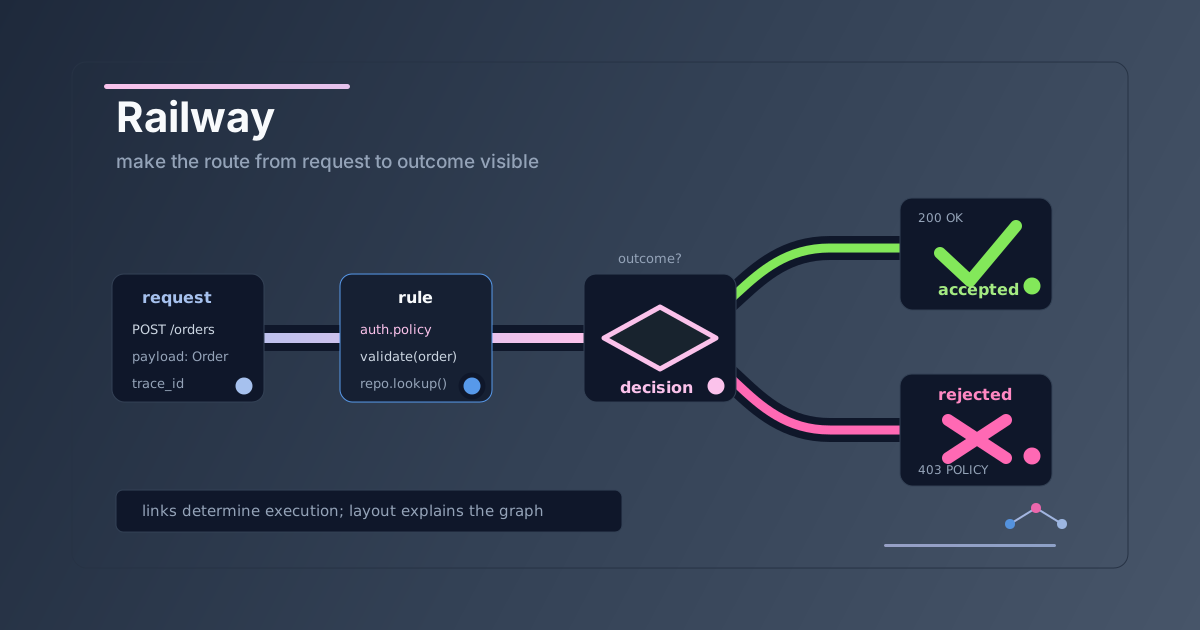
Railway-Oriented Programming is already an established concept in software development. Popularized by Scott Wlaschin and others, it describes composing operations that can succeed or fail. An expected failure becomes an explicit outcome that the next operation can handle, instead of disappearing into an exception or being ignored.
When someone asks, "Why was this order rejected?", the answer is rarely in one place.
The business rule might live in application code, the authentication policy in another service and the data change in a repository. Each part may work, yet the path connecting them is difficult to see.
Railix borrows that idea and asks a broader question: what if you could see how a request moves through business rules, permissions, data changes and outcomes without stitching the story together from scattered code?
A Diagram That Determines Behavior
Many teams already draw flows. The problem is that a diagram can drift away from the code it is meant to explain.
Railix treats Flows and Steps as an executable application model. The links between Steps determine execution; the visual layout helps people navigate it. The compiler turns the model into an application rather than asking a production workflow engine to interpret the diagram on every request.
This gives different people a shared place to ask precise questions. A developer can inspect the input to a decision. A product manager can check whether the route matches the intended rule. Support can trace the outcome of a concrete example.
The model is useful only if those questions connect to actual behavior, so examples and observed executions matter alongside the graph.
Failure Is Part Of The Route
A railway is most valuable where things do not go as planned. A rejected input, a missing permission and an unavailable dependency are different outcomes. Giving them explicit routes makes their handling easier to review.
The aim is to make all decision paths, including failure modes, visible and testable.
Build From The Path
Railix currently generates Java for a modeled Flow and compiles it to JVM bytecode. The generated application follows declared Step links and outcomes; it does not interpret the project graph at runtime.
A self-contained application artifact and native machine code for generated applications are part of the goals.
Compilation matters here because the model is more than a presentation layer. It is the source from which the application is built. The long-term goal is to carry platform and operations into the same model, so the team can connect what it intended to build with what actually ran.
That is the railway railix is building.
More about railix: https://railix.mitbauen.space/