What If Building Systems Felt Like Playing A Game?
Railix explores how visual executable models can make software products visible, verifiable and portable.
What if building systems felt like playing a game?
That question sounds playful but it comes from a serious frustration.
Software often starts simple. Then the product grows, delivery grows around it and the knowledge of how it really works starts to spread across too many places.
Some behavior lives in code. Some in YAML. Some in deployment scripts. Some in runbooks. Some only in the heads of people who have seen production fail before.
After a while, the product is no longer one understandable thing.
It is code, glue, secrets, examples, infrastructure rules and operational folklore trying to stay in sync.
One Executable Source Of Truth
Nano showed that Java services can be smaller, explicit and lighter to run. Railix is the next big step for NanoNative.
Railix starts from the idea that a product should be modeled once. Not once as a diagram, once as code, once as deployment configuration and once again as a runbook. One model should be useful while the product is designed, verified, compiled, deployed and operated.
Railway Oriented Programming As A Product Shape
Railix treats Railway Oriented Programming as a practical model for building software.
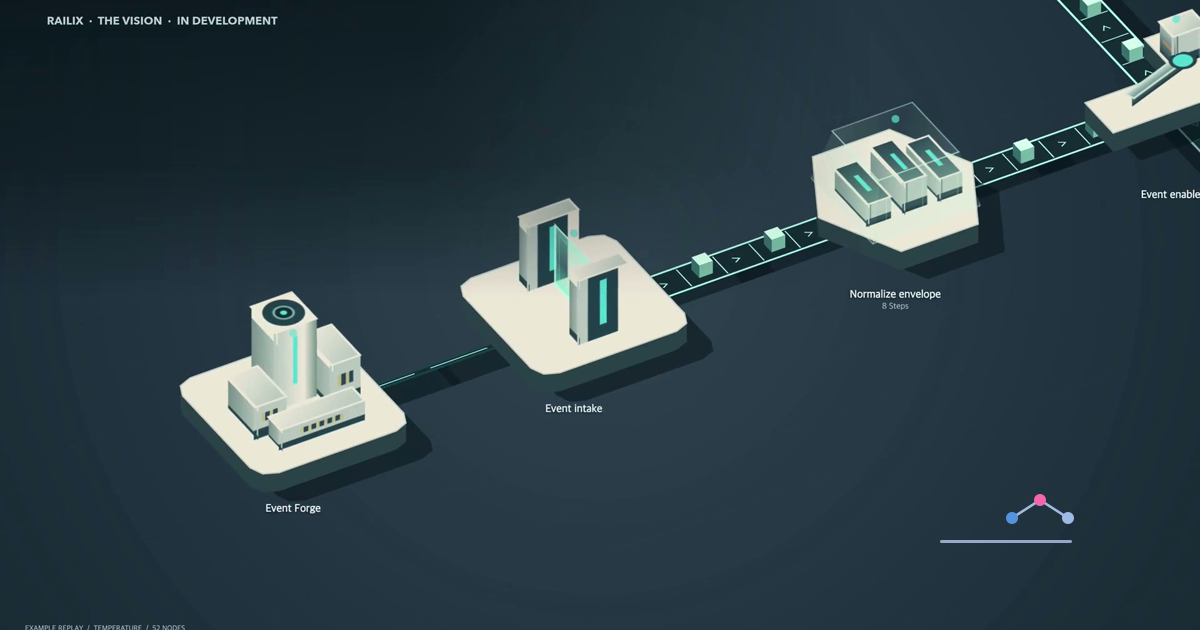
A system has a track. Data enters. Steps transform it. Decisions branch. Failures take visible paths. Examples prove what should happen before anything ships.
This matters because the flow of data is usually the first thing that gets lost. People remember the individual pieces but not all the routes. They know the handler, the script, the datalake and the support note but the actual journey through the system has to be reconstructed from memory or on a whiteboard.
Railix is not trying to add another layer on top of old complexity. It is trying to make software visible again.
Developer Experience Is Not Only Abstractions
Developer experience is often reduced to pnemonic APIs and better abstractions. Those things matter but they are not the whole story.
A good DX also means that the system helps one understand it. We can see where data enters, which step changed it, where it can fail. We can test the path locally before production becomes the first place that connects the dots between Code, Platform & Product Management.
That is why examples matter in railix. Examples become living specifications. They prove the model before an artifact is created. The product becomes easier to reason about because the model, verification and runtime boundary come from one source of truth.
Visible, Verifiable And Portable
Railix explores what happens when the product itself becomes visible, verifiable and portable.
One model. One Binary. Your infrastructure.
That direction matters because teams should not have to trade understanding for convenience. A product can be created with a visual executable model and still compile toward a portable application that runs where the team needs it to run.
And once the tool becomes good enough, the work changes. We stop babysitting glue and start designing the system like terrain in a strategy game.